como poner los subtitulos en espanol en dramacool como poner los subtitulos en espanol en dramacool
como poner los subtitulos en espanol en dramacool Home News Planets Renderings Objects Drawings Tutorials como poner los subtitulos en espanol en dramacool
The Sun Mercury Venus Earth Mars Jupiter Saturn Uranus Neptune Pluto

Como Poner Los Subtitulos En Espanol En Dramacool |link| (UPDATED)

En este artículo, te hemos mostrado cómo poner los subtítulos en español en DramaCool de manera fácil y rápida. Recuerda que no todos los dramas tienen subtítulos en español disponibles, pero muchos de ellos sí los tienen. Si sigues teniendo problemas, no dudes en contactar con el equipo de soporte de DramaCool. Esperamos que disfrutes viendo tus dramas asiáticos favoritos con subtítulos en español.

Haz clic en el icono de la extensión y selecciona el video que se está reproduciendo.

Este es el método más sencillo si estás utilizando una computadora o una laptop con navegadores como , Microsoft Edge o Brave . No necesitas instalar nada adicional. como poner los subtitulos en espanol en dramacool

Configura el idioma de salida como . La extensión leerá el código de los subtítulos en inglés y superpondrá la traducción al español en la pantalla de forma automática.

Afortunadamente, existen métodos sencillos y gratuitos para solucionar esto y ver todo el contenido con subtítulos en español perfectamente sincronizados. En este artículo, te hemos mostrado cómo poner

Si tienes problemas para encontrar subtítulos, ¿podrías decirme qué drama estás intentando ver y si estás en PC o móvil? Así puedo darte una solución más directa.

Si necesitas ajustar la configuración de los subtítulos, puedes hacerlo siguiendo estos pasos: No necesitas instalar nada adicional

En Safari (iOS) o Chrome (Android), usa la opción "Traducir página". Esto funciona mejor si el reproductor utiliza subtítulos basados en texto (softsubs) en lugar de estar pegados al video (hardsubs). Consejos adicionales para una mejor experiencia

: Se ha consolidado como una plataforma muy potente con un enorme catálogo de K-Dramas y C-Dramas, y suelen incluir subtítulos oficiales en múltiples idiomas, incluido el español.

se enfocan específicamente en público hispanohablante y ya traen los subtítulos integrados en nuestro idioma. : Canales oficiales como KBS World Spanish

No todos los servidores de video dentro de la página web funcionan igual. Cuando abras un capítulo, notarás una lista de opciones en la parte superior o lateral. Te recomendamos elegir:

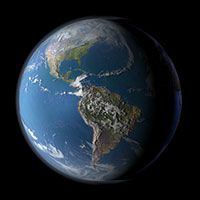
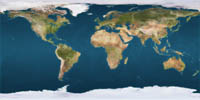
This map is a synthesis between my original earth map, gradient mapping of the USGS DEM information, hand painting, DEM modulation of detail, bathyspheric depth information, and the USGS Ocean clip. Bathyspheric data was used to modulate the color of the water so that deeper areas are a darker blue than shallow areas.
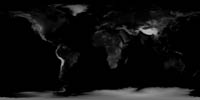
This is pieced together exclusively from the USGS DEM database. It contains landmass elevations only, with the ocean at zero, and the top of Mt. Everest at 255. Use this as a bump map to give the appearance of the Earth's rugged surface features. Some madmen have also used this data in POV Ray as a displacement map on a very finely divided sphere to produce a "true" 3D version of the Earth. The 10K version is VERY large, so make sure you really need that much detail.
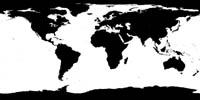
This is derived from USGS DEM data, with the addition of the Arctic ice areas which do not show up on USGS data (since they are not solid land masses.) Use this to control specularity and reflectance of the ocean surface.
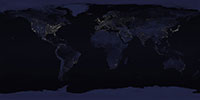
1024 x 512 color image. Very similar to the night lights map as published by NASA on their Blue Marble Page. I took their 30000 x 15000 black and white city lights map, and adapted it with a color table to a colorized version of my earth color map. This comes in 2k, 4k, and 10k versions in color, as opposed to the maximum 2k size of the NASA version of this map (higher resolution versions are available on the paid page only because of their size). Be sure to have a look at the tutorials page for a special rendering tip for using this map.
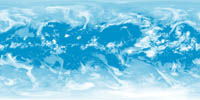
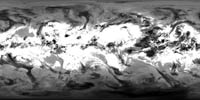
1024 x 512 color image. Based on a mosaic of satellite data, colorized, data errors retouched out, and fixed for seamless wrapping.
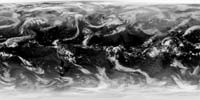
1024 x 512 greyscale image. Based on the same data as the color map, but leveled for the purpose of transparency mapping.

4096 x 2048 greyscale image. Built up out of real satellite imagery based upon a tutorial Dean Scott of Silicon Magic has posted. This is posted in JPEG2000 format. You need a special Photoshop plug-in to make use of jp2 images. I've thoughtfully provided a link:

JPEG 2000 Plugin from Fnord.

Como Poner Los Subtitulos En Espanol En Dramacool |link| (UPDATED)

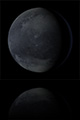
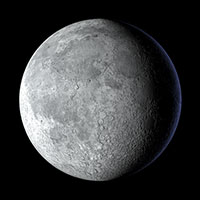
The Moon is a tricky planetoid to render. It has a very distinctive albedo which remains constant across its lit side, regardless of the angle of the surface to the sun. Therefore, standard rendering lighting models do not apply, as they always have a characteristic drop off in intensity as the angle of incidence to the light source increases. In Lightwave, there is an option to use a "non-Lambertian" lighting model on a surface setting. In previous versions of Cinema4D, you had a contrast control in the lighting setup. More recent versions of Cinema4D feature an Oren/Nayar illumination model in the lighting setup which allows you to simulate the lighting properties of "rough" surfaces. This is the method I used on the same pictured here.

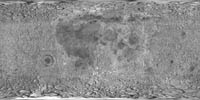
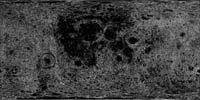
This map is based on a mosaic of satellite data, retouched for visible mosaic seams and for problems with the wrapping seam. Since this image contains highlight and shadow information independent of the location of your light source (inevitable because of how the moon is illuminated by the sun), you'll need to be careful how you light this so you don't break the illusion.

This map is my attempt to derive bump information from the above map. I did a high-pass filter operation to find all the edges of the craters, and then curved the result so that blacks and whites were white, and mid-tones were black. The results came out pretty well, as you can see from the sample image above.


this site works
best on Firefox:


website design © 2006 james hastings-trew