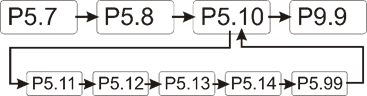
This section supplements the “LIS-SV”
product manual. The parameters described here are only available if the LIS-SV
is used in an ABULiner control unit.
Overview of the
'ABULiner' parameter level
The following parameters can be set in the 'ABULiner'
parameter level of the LIS-SV.
|

|
Danger during setting work!
During setting work on the LIS-SV, monitoring of
the wire rope hoist is switched off. This means the wire rope hoist cannot
be monitored for excess load, among other things. This means the
wire rope hoist cannot be monitored for excess load, among other
things.
This in turn means the load could fall and kill or
injure people!
Do not use the crane for normal work during
setting work, and only lift loads very carefully for test
purposes! |
All LIS-SV parameters which are important for the ABULiner
are combined in a separate parameter level, which is shown as a submenu.
 Move the load hook out of
the limit switch range (up or down).
Move the load hook out of
the limit switch range (up or down).
During parameter setting, the load hook must not be within the
limit switch range.
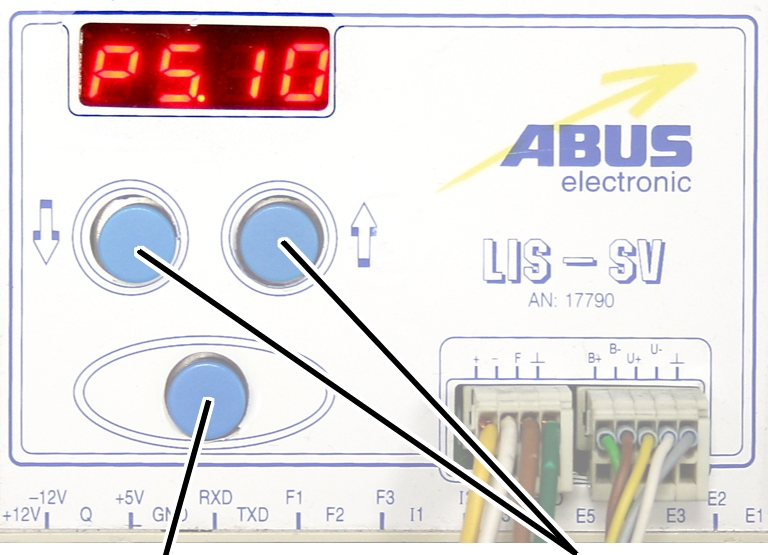
Open the menu of the
LIS-SV. See the documentation “Load indicator system LIS-SV”.
|
|
|
Enter
button |
Arrow
buttons |
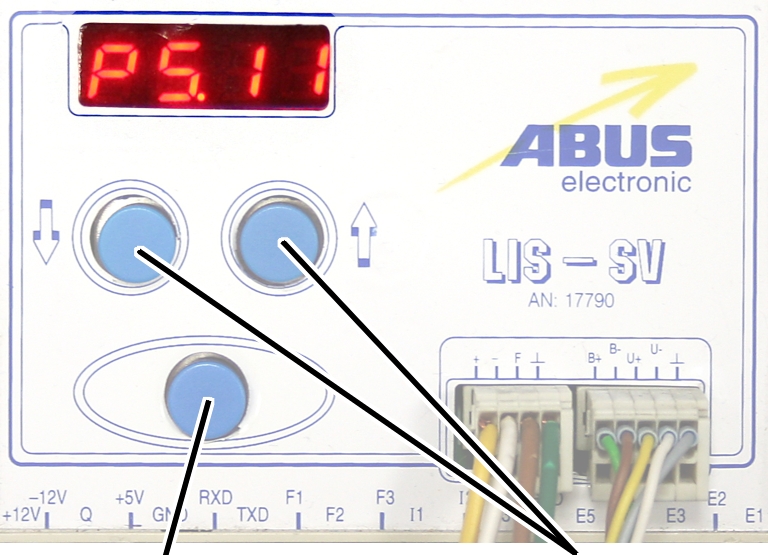
 Select parameter 5.10.
Press ENTER.
● The
'ABULiner' parameter level is activated.
● Parameter
5.11 is displayed.
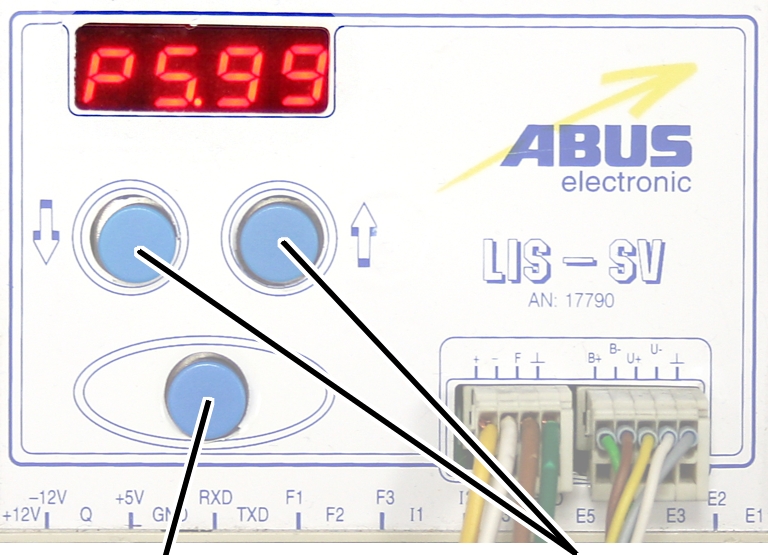
Exiting the
'ABULiner' parameter level
|
|
|
Enter
button |
Arrow
buttons |
Select parameter 5.99.
Press ENTER.
● The
previous parameter level is reactivated.
● Parameter
5.10 is displayed.
The LIS-SV is automatically activated for the ABULiner if a
value is entered for the parameter 5.11.
In the ABULiner mode (a value is set for parameter 5.11):
─ The
LIS-SV can monitor the total load for a maximum of two wire rope hoists.
─ Input F3
(normally used for measuring the load of wire rope hoist 3) now serves in
monitoring the current rotational frequency of the hoist motor.
─ A value
can be entered for parameter 3.0 (maximum load capacity of wire rope hoist 3).
If a value is entered for this, parameter 5.11 cannot be set.
─ This
interlocking thus excludes an incorrect setting.
─ The
load-controlled switching point at output TxD of the LIS-SV cannot be used.
─
Parameter 4.5 (setting for load-controlled switching point) is not available.
In the normal mode (no value is set for parameter 5.11):
─
Operation of the ABULiner Lifting/Lowering unit is not possible.
─ The
LIS-SV can monitor the total load for up to three wire rope hoists.
─ Input F3
serves in measuring the load of a third wire rope hoist.
─ A value
can be entered for parameter 5.11 (gear ratio). If a value is entered for this,
parameter 3.0 cannot be set.
─ This
interlocking thus excludes an incorrect setting.
─ The
load-controlled switching point at output TxD of the LIS-SV can be used.
─
Parameter 4.5 (setting for load-controlled switching point) can be used.
The LIS-SV uses the signal of the encoder and the gear ratio
of the hoisting gear to calculate the hook travel distance, the maximum distance
in the limit switch range and the current rotational frequency of the hoist
motor. The gear ratio must be set on the machine.
|
|
|
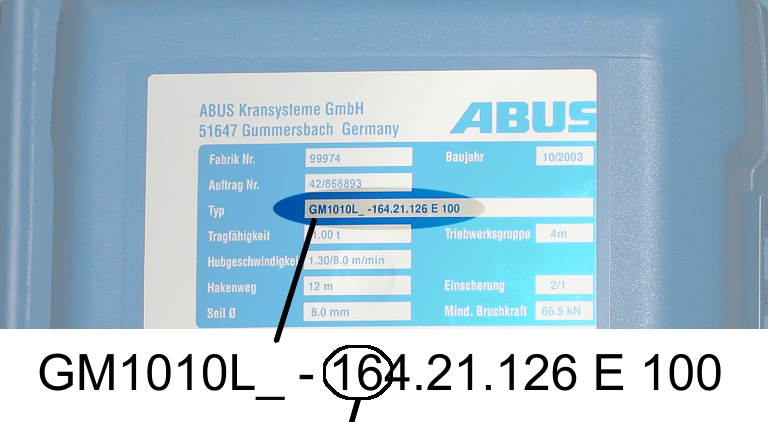
Cable
speed |
|
Read off the type
designation at the type plate of the wire rope hoist.
Read off the cable
speed.
From this table, select
the gear ratio that matches the cable speed.
|
|
Cable
speed |
|
Hoist motor GM |
32 m/min at 50 Hz
38 m/min at 60
Hz |
25 m/min at 50 Hz
30 m/min at 60
Hz |
20 m/min at 50 Hz
24 m/min at 60
Hz |
16 m/min at 50 Hz
19 m/min at 60
Hz |
|
800.4 |
50.01 |
63.49 |
77.77 |
98.16 |
|
800.5 |
47.03 |
60.04 |
74.66 |
95.03 |
|
1000.6 |
54.43 |
68.91 |
84.00 |
105.1 |
|
1000.7 |
54.60 |
68.06 |
81.45 |
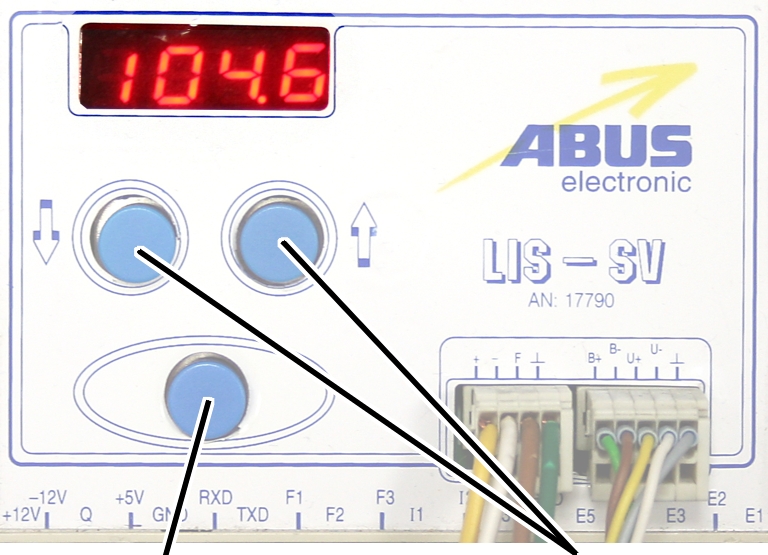
104.6 |
|
2000.3 |
58.22 |
74.23 |
91.19 |
118.4 |
|
3000.4 |
73.61 |
93.92 |
118.4 |
152.9 |
|
5000.3 |
85.14 |
109.3 |
132.8 |
169.0 |
|
5000.4 |
80.20 |
104.9 |
127.7 |
160.6 |
|
6000.3 |
94.69 |
118.5 |
149.6 |
182.7 |
|
7000.1 |
118.0 |
148.3 |
182.6 |
232.0 |
|
|
|
|
|
|
Table: Gear ratios (numerical values) depending on
hoist motor (lines) and cable speeds (columns) at 50 and 60 Hz.
|
|
|
Enter
button |
Arrow
buttons |
Move the load hook out of
the limit switch range (up or down).
During parameter setting, the load hook must not be within the
limit switch range.
Select parameter 5.11.
Press ENTER.
● The set
value is displayed.
If the value is 0.00, the function is deactivated.
● Hold ENTER
pressed.
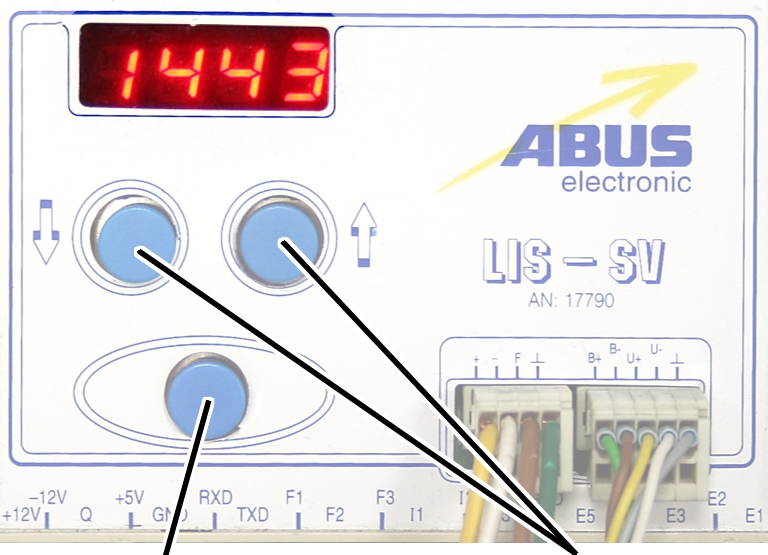
● CODE is
displayed.
Hold ENTER pressed.
|
|
|
Enter
button |
Arrow
buttons |
Enter the code 1443.
Press ENTER briefly.
|
|
|
Enter
button |
Arrow
buttons |
Set the value from the
table.
If the display ‘0.00’ cannot be changed, a value is set in
parameter 3.0. In this case, set the value to zero first.
Press ENTER briefly.
-hdlove- Noelle Easton - Ohh Noelle -02.01.2014-: !!top!!
Performances from this era (2013-2015) are often archived on major adult streaming platforms and databases. For historical and industry tracking, detailed records of this specific release can be found on the IMDb Full Cast & Crew page, which lists the technical contributors and performers involved in the January 2014 production. Share public link
: The release date stamp. In standard metadata indexing, appending the date prevents confusion between scenes with similar names and allows collectors to establish a chronological timeline of a studio's output. Technical Specifications and Production Value
Brands like HDLove built their business models around clean, high-fidelity visuals. The title "Ohh Noelle" is structured as a performer-centric showcase, a highly popular format at the time designed to market a scene entirely around the star power of a single individual. Digital Footprint and Archival Status -HDLove- Noelle Easton - Ohh Noelle -02.01.2014-
The story meticulously traces the evolution of Noelle Easton's relationships, providing a nuanced portrayal of how love can manifest in various forms. From the euphoria of newfound love to the resilience required in the face of challenges, each phase of Noelle's journey offers valuable insights into the dynamics of human relationships.
In the vast and often ephemeral world of digital media, certain strings of text act as archaeological markers. To the uninitiated, a filename like might look like a random collection of hyphens, names, and numbers. But to media archivists, digital historians, and fandom communities, these strings are a Rosetta Stone. They tell us about production houses, performer identities, stylistic branding, and the era of internet content distribution in the mid-2010s. Performances from this era (2013-2015) are often archived
In the early 2010s, "HD" was not just a technical specification; it was a premium marketing buzzword. Studios prefixed their brands with "HD" to signal to consumers that they were investing in high-end camera packages, professional lighting setups, and advanced digital encoding.
Beyond her work in HD Love, Easton has appeared in numerous major series including Baby Got Boobs and Doctor Adventures. In standard metadata indexing, appending the date prevents
The phrase embedded in the filename is not a typo or random exclamation. It is most likely the title of a specific scene or a recurring segment within the HDLove ecosystem.
The "Ohh Noelle" episode was designed as a showcase feature. During this era, network studios utilized solo and close-up performance vignettes to build a performer's portfolio, leverage search engine traffic, and drive subscription conversions across digital platforms. Legacy and Digital Archiving
In Ohh Noelle , the production team leaned hard into this aesthetic. The scene opens with soft, diffused window light hitting a simple, uncluttered bedroom. There are no dramatic sets or elaborate costumes—just Noelle in comfortable, everyday loungewear. This simplicity was HDLove’s signature move, and it paid off.
Only for auxiliary fans
The auxiliary fan of the hoist motor continues to run for
several minutes after the lifting or lowering. This ensures that the hoist motor
is adequately cooled even at slow lifting speeds. The run-on time can be
adjusted.
|
|
|
Enter
button |
Arrow
buttons |
Move the load hook out of
the limit switch range (up or down).
During parameter setting, the load hook must not be within the
limit switch range.
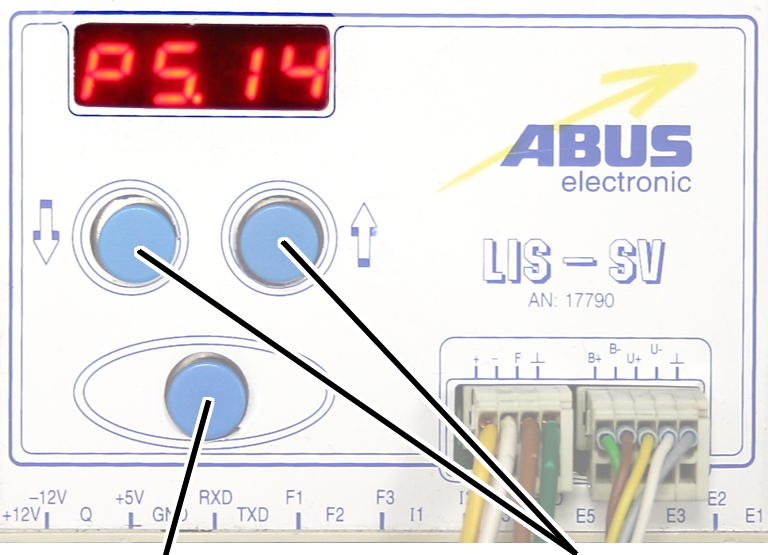
Select parameter 5.14.
Press ENTER.
● The set
value is displayed.
|
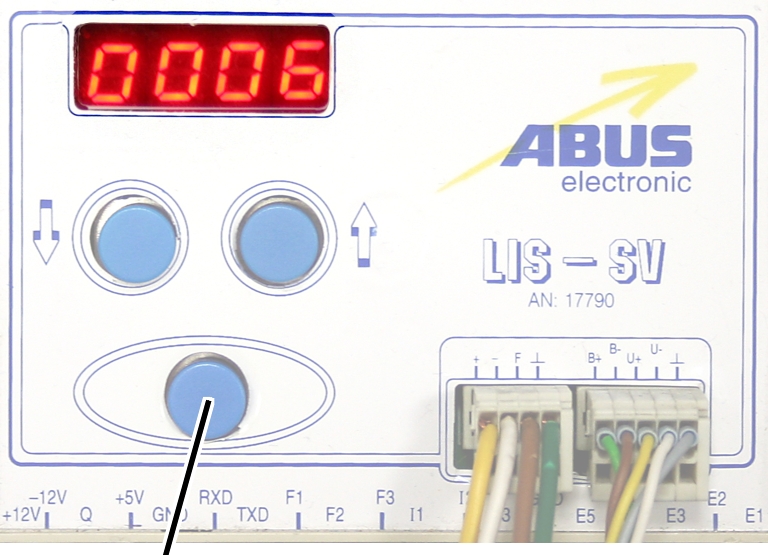
|
|
Enter
button |
|
Set the value to between 3
and 10 minutes using the arrow buttons.
Press ENTER.